
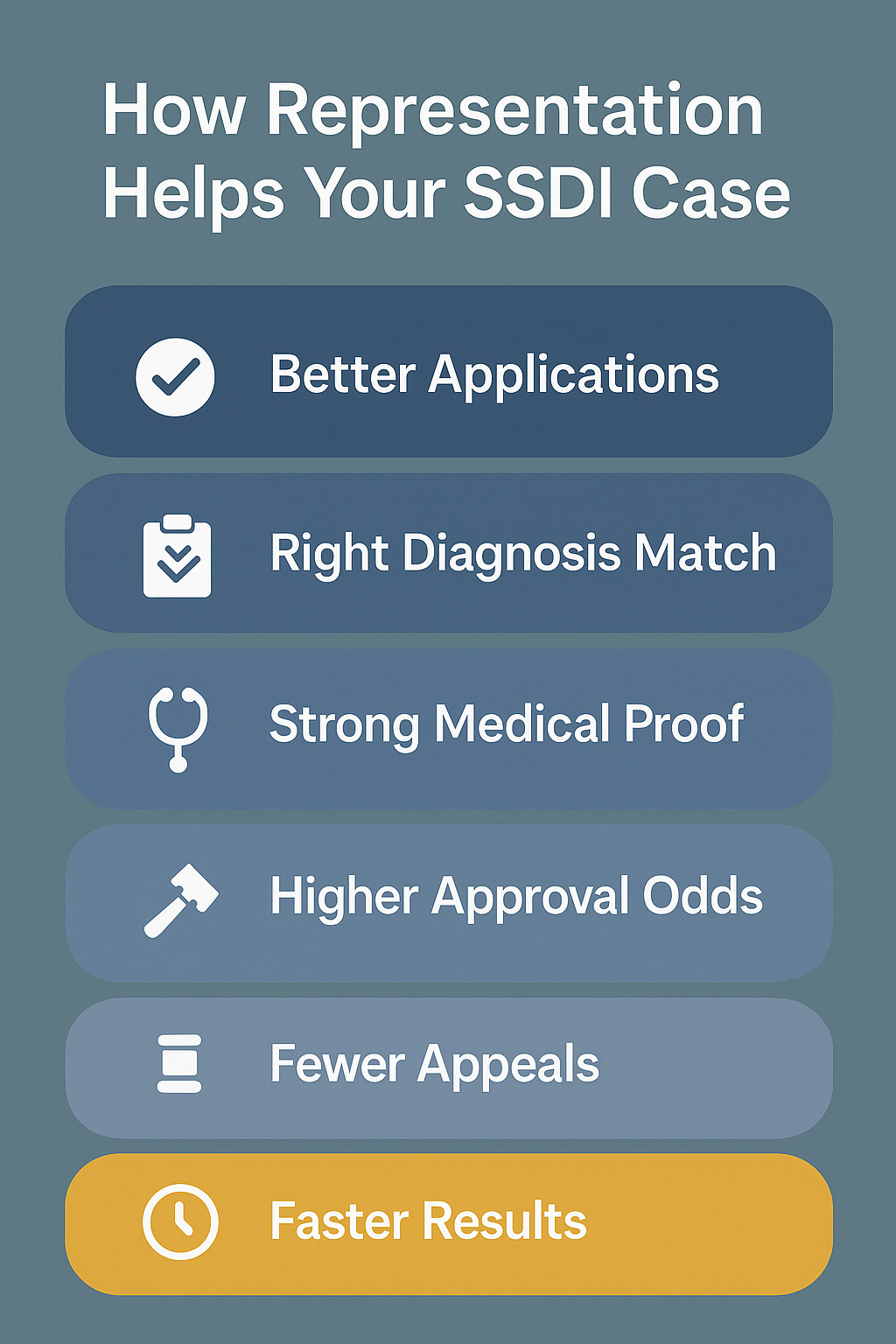
 When applying for Social Security Disability Insurance (SSDI) or Supplemental Security Income (SSI), one of the most common questions claimants ask is:
“What actually improves my chances of winning disability benefits?”
A comprehensive report from the U.S. Government Accountability Office (GAO), which analyzed more than 600,000 disability hearing decisions from 2007–2015, provides clear, data-driven answers. The findings show that representation, expert testimony, hearing format, and even which judge you are assigned can dramatically influence whether a claimant is approved1 .
Below, we break down the most important insights from the GAO report—and what they mean for anyone applying for disability benefits today.
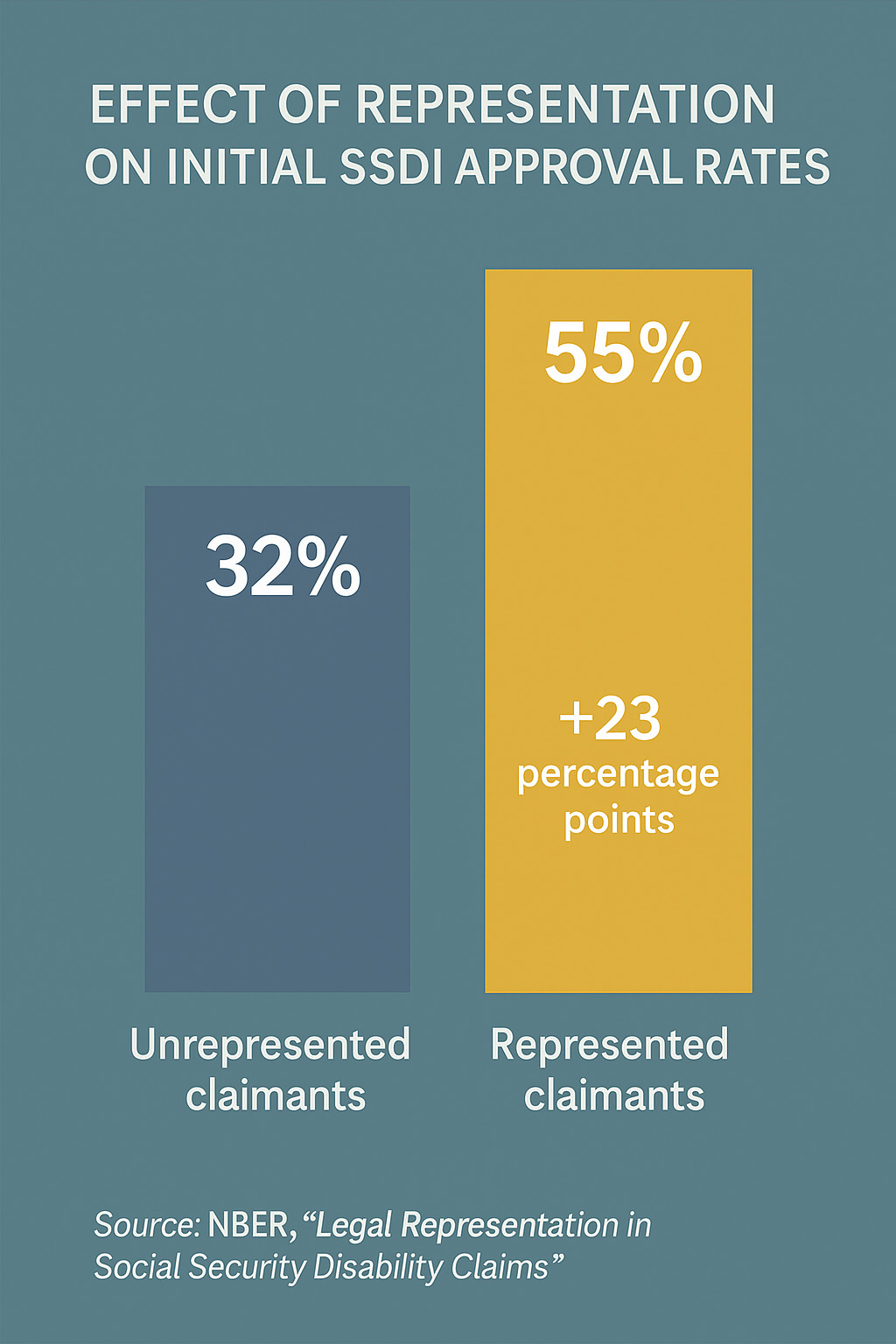
1. Claimants With Representatives Are Nearly 3× More Likely to Be Approved
The single strongest predictor of a successful disability appeal is having a representative—whether an attorney or qualified non-attorney advocate.
According to the GAO:
- “Claimants who had representatives… were allowed benefits at a rate nearly 3 times higher than those without representatives.”
The report further shows:
- “Claimants who had a representative… were allowed at a rate 2.9 times higher than a typical claimant with no representative.”
Why the dramatic difference? Representatives help gather medical evidence, identify errors, prepare arguments, and ensure the case is presented clearly and correctly at the hearing. Even the GAO notes that representatives are highly selective and take cases they believe can succeed—but they also make those cases stronger.
2. Claimants whose hearings involved a medical expert were allowed at a rate 1.6× higher than those without one.
Medical experts play a crucial role in explaining the severity of a claimant’s condition.
The GAO found:
- “Claimants whose hearings involved testimony from a medical expert were allowed at a rate 1.6 times higher than a typical claimant without a medical expert present.”
Medical experts help clarify whether an impairment is equivalent to one in SSA’s Listing of Impairments—often a decisive factor in being approved.
3. Claimants benefit from personalized, human-centered representation. In-person hearings resulted in a 1.1× higher allowance rate.
While SSA increasingly uses video hearings for efficiency, the GAO found a measurable advantage for claimants who appear in person:
- “Claimants whose hearings were held in person were allowed at a slightly higher rate (1.1× higher), equivalent to a 2.8 percentage-point increase compared to videoconference hearings.”
In-person hearings allow judges to better evaluate demeanor, clarity, and symptoms, reinforcing the importance of human-centered representation.
4. Navigating the application and appeal process can be complex as outcomes are affected by judges.
Allowance rates can vary by as much as 46 percentage points depending on which judge hears a typical claim. Judges appointed between 1995–1999 allowed benefits 1.5× more often than judges appointed after 2010.
One of the most surprising findings is how much outcomes vary depending solely on which judge hears the claim.
The GAO states:
- “The allowance rate could vary by as much as 46 percentage points if different judges heard a typical claim.”
This variation remains even after controlling for:
- disability type
- age
- education
- office location
- representation
- expert testimony
This means that two claimants with identical cases could receive very different outcomes purely due to judge assignment.
Judge training and policy era also influence outcomes. According to the GAO:
- “A claimant whose claim was heard by a judge appointed between 1995 and 1999 was allowed at a rate 1.5× higher than a typical claim heard by a judge appointed after 2010.”
This suggests that newer judges—trained under more restrictive guidance—tend to be more conservative in approving claims.
What This Means for Disability Claimants
The GAO research paints a clear picture:
✅ Representation matters—more than almost anything else
✅ Proper medical evidence dramatically improves outcomes
✅ Vocational testimony can hurt your case without preparation
✅ In-person advocacy gives claimants an edge
✅ Outcomes depend heavily on judge variation and procedural complexity
The Social Security disability process is not just about medical eligibility—it is about navigating a highly technical, evidence-heavy, and often inconsistent system. That’s why professional support makes such a measurable difference.
Final Thoughts: You Don’t Have to Navigate Disability Benefits Alone
For anyone applying for SSDI or SSI—especially those heading into the hearing stage—the data is clear:
Structured support, expert guidance, and professional representation significantly improve the likelihood of winning benefits.
Citation Source Work
1SOCIAL SECURITY DISABILITY Additional Measures and Evaluation Needed to Enhance Accuracy and Consistency of Hearings Decisions Report to the Chairman, Subcommittee on Social Security, Committee on Ways and Means, House of Representatives United States Government Accountability Office. 2017.